Back to WizoCat

The Archmage's Workshop

WizoCat didn't come out of a factory. It was born on a table, out of cut-up cardboard, re-cut tiles and botched games. Here are the steps, in the order they happened.

Why Dick Dastardly never wins

Before the first tile, there are memories. The most useful of them all comes from a cartoon: in Wacky Races, Dick Dastardly and Muttley are the only racers whose entire strategy is to harm the others. Traps, wrong turns, bombs — and they never win. Not because the script punishes them: because they stop to sabotage while the ten others keep driving.

That became a design rule, and I think it is the most important one in the game. I forbade nothing. An apprentice has two actions and one tile move per turn, and whatever they spend for the sole purpose of hindering a neighbour, they do not spend on themselves. WizoCat does not forbid sabotage, it bills it — and the bill is their own diploma. A ban can be worked around; a cost cannot.
Seeds were planted, WizoCat sprouted

The tone and the humour of the lore, those I owe largely to Terry Pratchett. What I love in him is the gap between the grandeur of the fantasy world and the very administrative pettiness of those who live in it. Magic may well be the most important thing in the world, but at the University what counts above all is knowing the rules, the titles, the precedences, and how to manoeuvre your way up the ladder. That is the gap I wanted to reinvent in WizoCat.

That tone is everywhere in WizoCat, and not only in the texts and the lore booklet: cats cast spells, but they sit a final examination, earn a diploma and complete a curriculum in an Academy that has its charter and its register. The whole vocabulary of the game comes from school, not from the grimoire. Le Donjon de Naheulbeuk did the rest: the ill-assorted band that grumbles, bickers, and ends up being endearing.

And then there are the tables. The tile games you lay down and turn over: Carcassonne, Kingdomino, Isle of Skye, Taluva, Tsuro, Cartographers, and Labyrinth, the very first board I ever saw move under my pieces. The ones where the ground gives way — Hey, That's My Fish!, Escape from Atlantis, Santorini. And the ones that showed me how deep a game can go: Terraforming Mars, Ark Nova, Magic, Lost Ruins of Arnak, The Isle of Cats, Keyflower.

WizoCat is none of them. But if you recognise something while playing it, that is probably no accident.

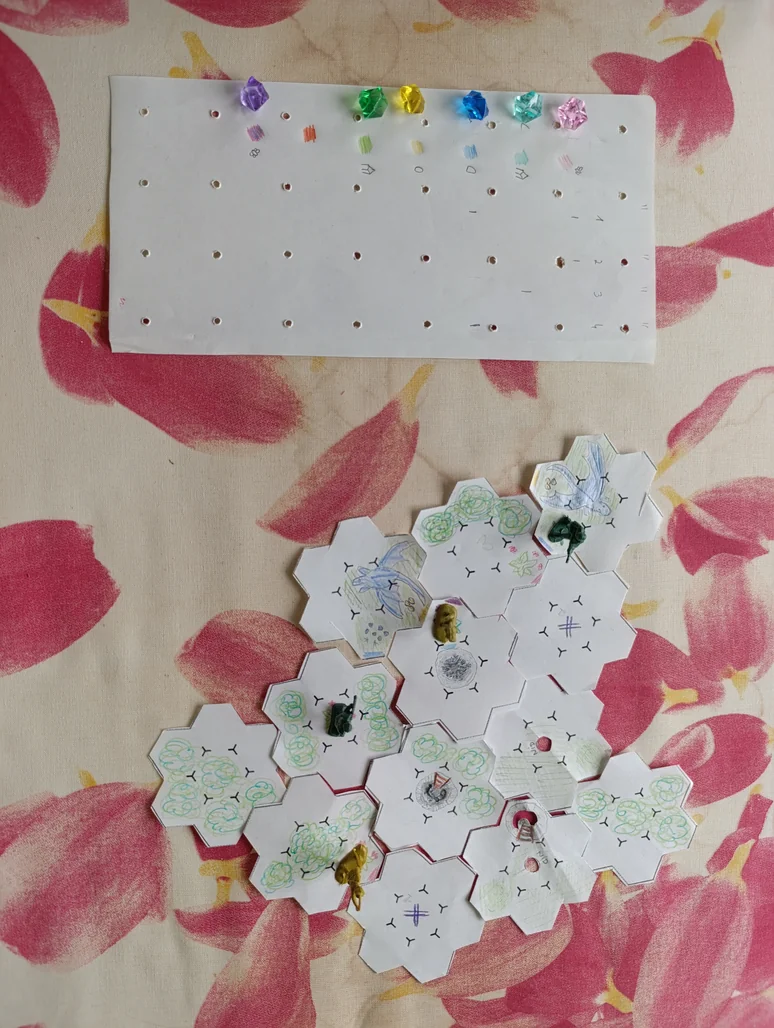
Paper prototype: hexagons drawn in coloured pencil, small green plastic figurines, and a sheet with a row of coloured gems. The first prototype ever photographed

A sheet of rules and some hexagons

The starting point: an evening four years earlier, at my stag do. I'd been given the challenge of making a board game in a single night… I didn't sleep… but by morning we were able to play the very first version! None of it survived as it was, but the question being asked was already the right one: what if the board moved?
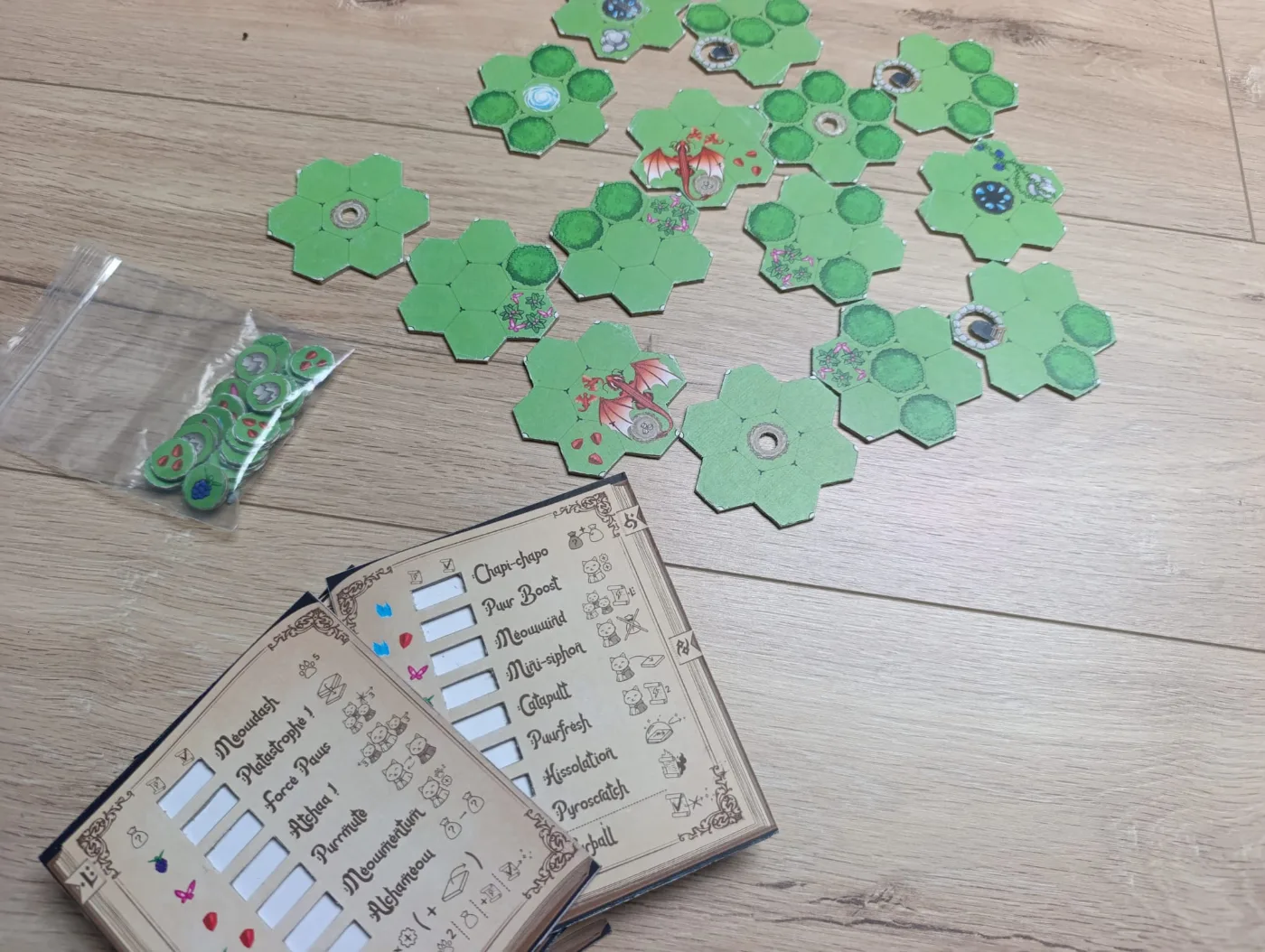
Here you can see the first photo of the game: hand-cut paper tiles, barely drawn on, a bag of gems standing in for resources, a few green plastic figurines found lying around, and the rules written in pen on a sheet of paper.

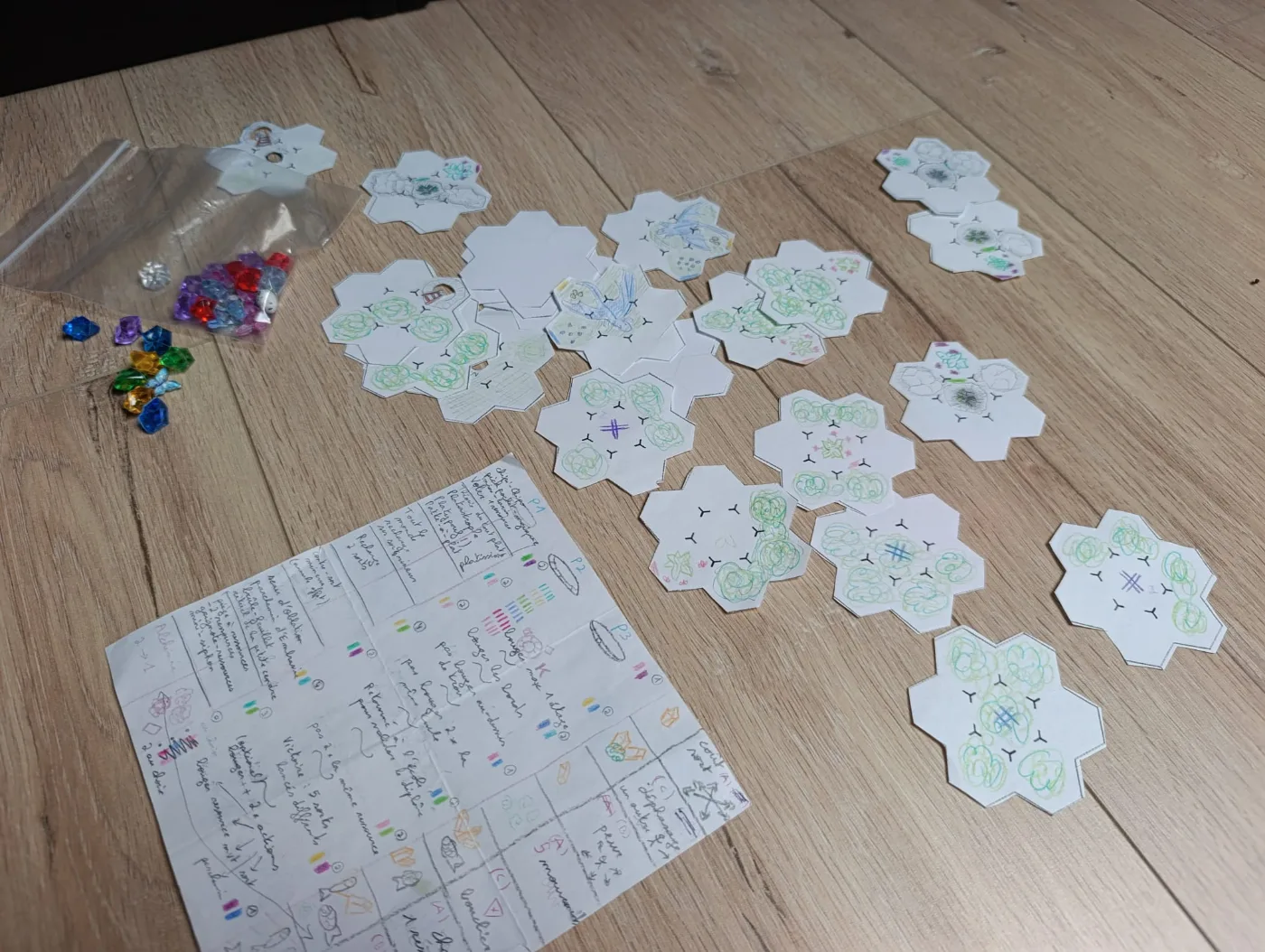
First WizoCat prototype lying on a wooden floor: barely drawn hexagonal tiles of light cardboard, a big handwritten sheet of rules, a bag of coloured gems. The paper prototype

Hexagons, gems and a lot of paper

Paper hexagons drawn in coloured pencil, and a sheet where coloured gems and charms, bought in bulk, serve as the resource counter. Everything is still played on paper. The slightest draught and the game is scattered to the four corners of the room.

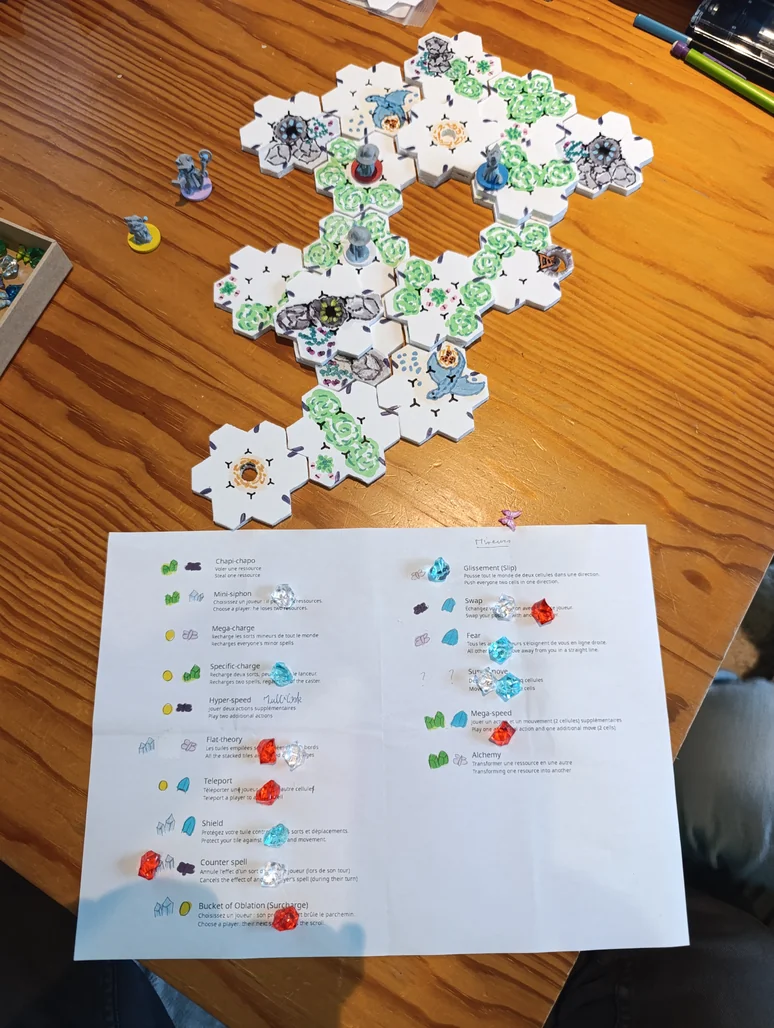
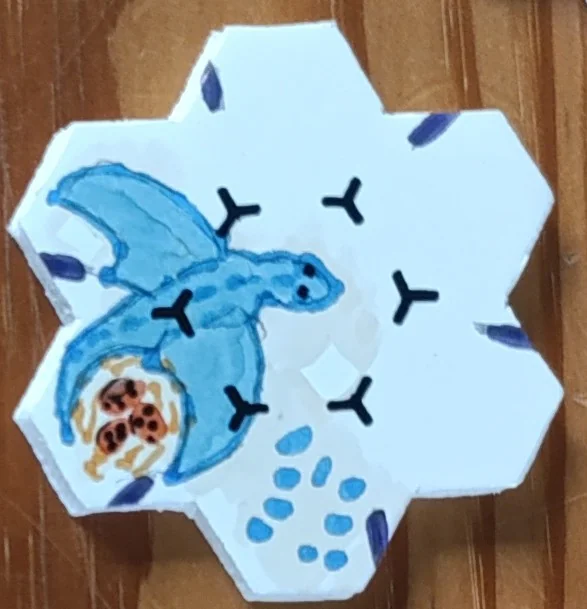
Prototype on a wooden table: white hexagonal tiles drawn in felt-tip, grey figurines on coloured bases, and a spell sheet printed in French and English with gems placed on it. Close-up of a hand-painted white hexagonal tile: a blue dragon with open wings holds a gem, surrounded by spaces marked with three strokes. Felt-tip tiles on foam board and a spell sheet

The spells get a sheet, the tiles get a dragon

The tiles are drawn in felt-tip, with spaces marked with three strokes, rocks, bushes and a blue dragon. The apprentices are grey figurines on coloured bases. In front, the first printed spell sheet, with the gems showing what each one costs.

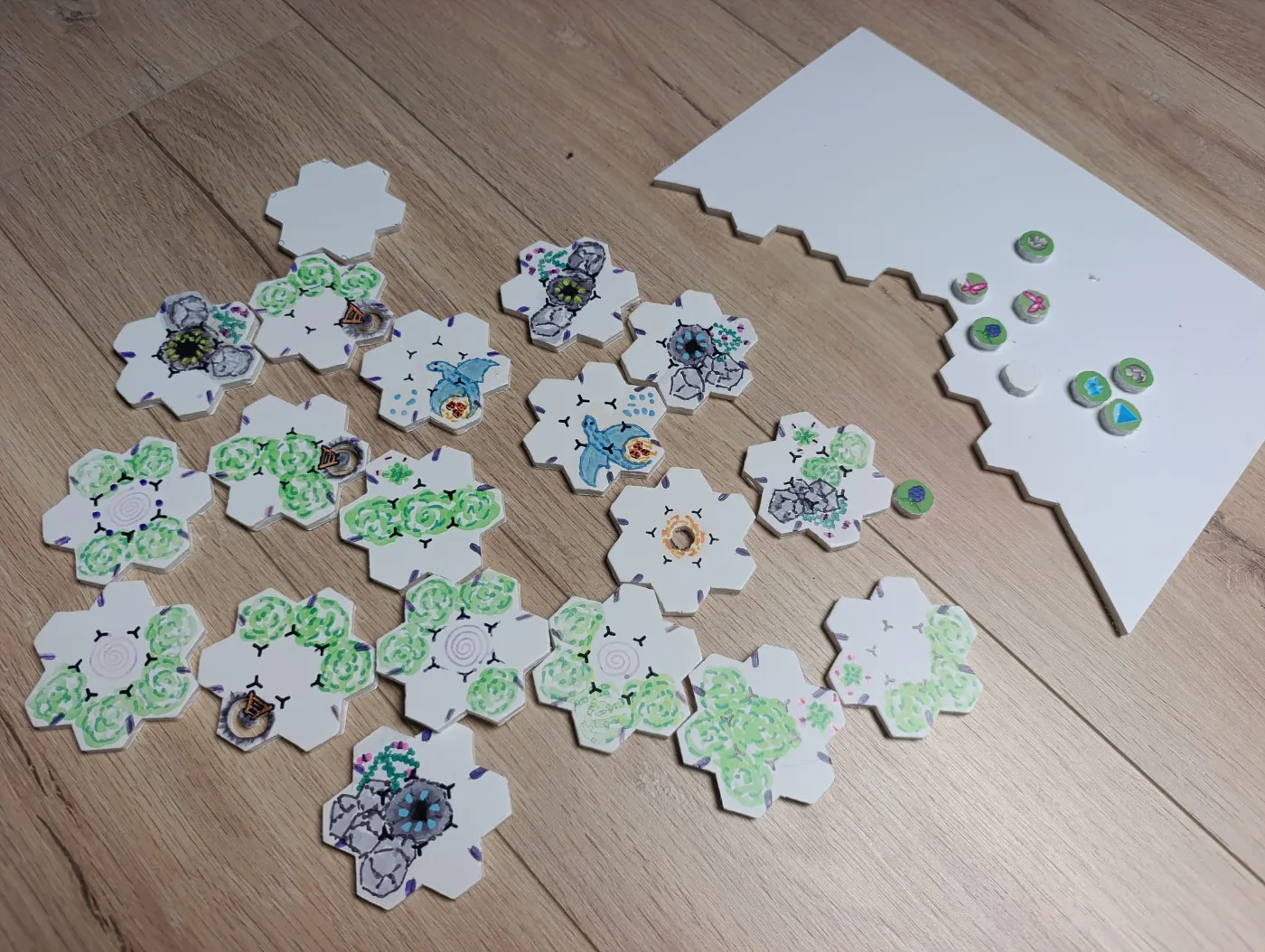
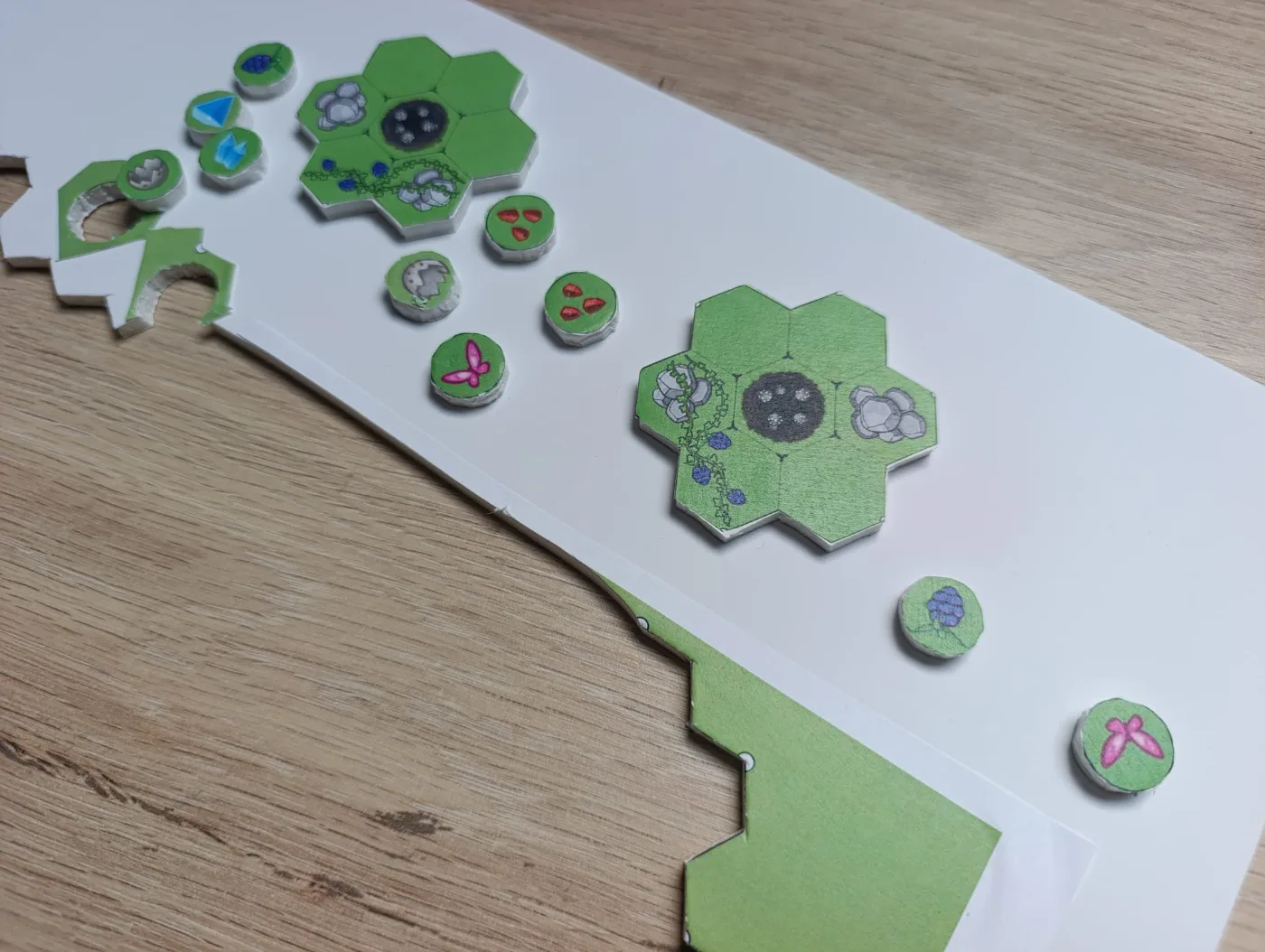
Intermediate prototype: hexagonal tiles of light cardboard covered in hand-drawn green and blue patterns, surrounded by many round tokens. Close-up of green hexagonal tiles printed in colour and cut from cardboard, with a few round tokens. Two intermediate steps

The tiles get their colours

A line is crossed: the felt-tip patterns give way to a crisp print, and the print is glued onto thicker foam board that really holds its own on the table. The game stays the same, but its readability changes everything, cutting down the time it takes to explain the rules by just as much.

Prototype v5: green hexagonal tiles scattered on a wooden floor, a bag of tokens, and a folded paper grimoire covered in a handwritten list of spells. WizoCat prototype v5 on a table: green hexagonal tiles, paper player boards, coloured tokens. Prototype v5

The game holds together on cardboard

Tiles printed and cut out one by one, cardboard player boards, a printed spell grimoire: it's still only a rough draft. At this stage it isn't pretty, and that's not the point. What we're checking is that the rules stand up once they're laid on a real table, in front of real players. The apprentices finally have real islands under their paw pads! In playtests, people are already asking for a level of detail on the board worthy of the cat illustrations I've started: all in good time, it'll come very soon.

Gantry laser engraver on an aluminium frame, with an engraved cardboard token lying on the bed. The laser engraver

A machine assembled at home

A gantry laser engraver, set up on the workshop table. It prepares the cut that I finish with a craft knife: the laser isn't powerful enough. It's a machine I assembled myself, for paper cutting and for engravings. It shows its age, this machine: I built it to make the invitations for my wedding. They were laser-cut butterflies. It's fun to look back on those moments; the emotion comes flooding back with the memories!

Prototype v9 mid-game: board of assembled hexagonal tiles, wizard cat figurines, open grimoire. Prototype v9, mid-game

The game finally looks like a game

Four versions later: the board is double thickness. I go to the nearest university town, where I am sure to find print shops. They do good-quality prints. The wizard cats stand proudly upright thanks to transparent acrylic stands, and the grimoire has its real layout. I haven't yet had time to finish the new drawings.

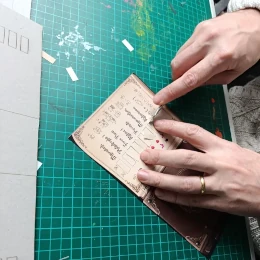
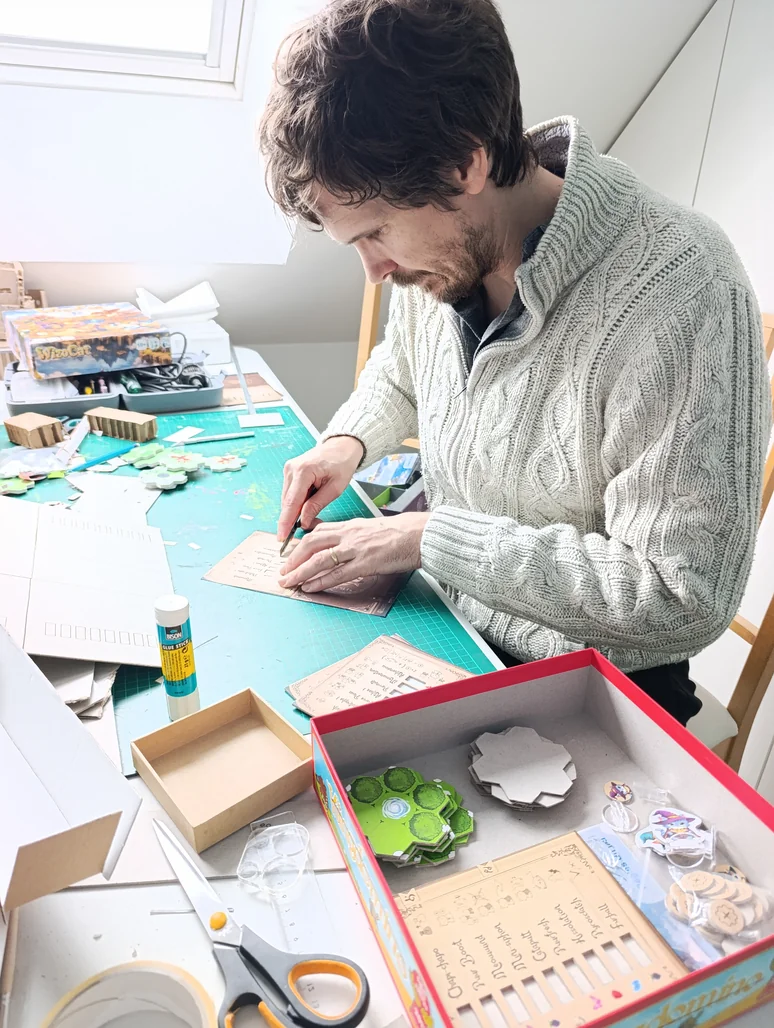
Two hands assembling a cardboard game piece on a green cutting mat. Christophe bent over a cutting mat, craft knife in hand, cutting out a player board; in the foreground an open box with green tiles and standees, in the background the closed WizoCat box. Cutting with a craft knife

Every piece passes through my hands

Cutting mat, craft knife, ruler. Every version of the prototype is rebuilt from scratch; that's the price to pay for being able to change a rule in the evening and test it the next day.

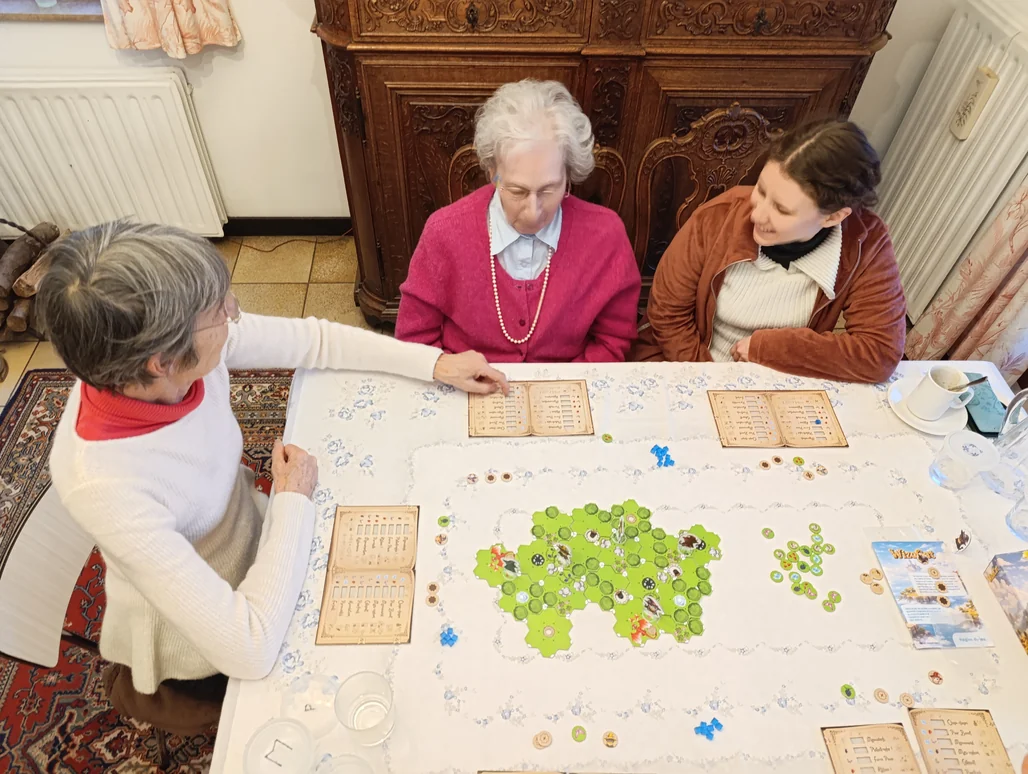
Top-down view of a table with a white tablecloth: three players from three generations, each in front of her open grimoire, around an assembled board of green tiles, with blue cubes and round tokens. With the family

Three generations around the table

We test the game as a family; there's something in it for every age.

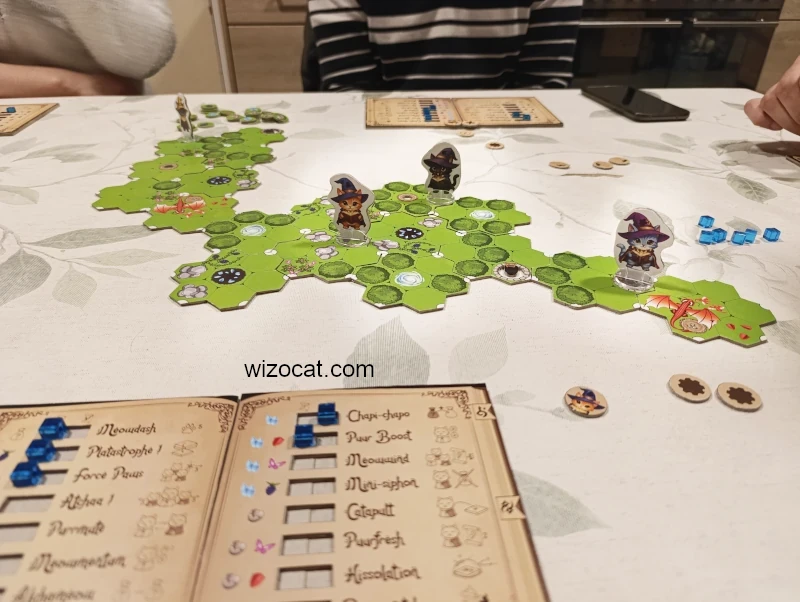
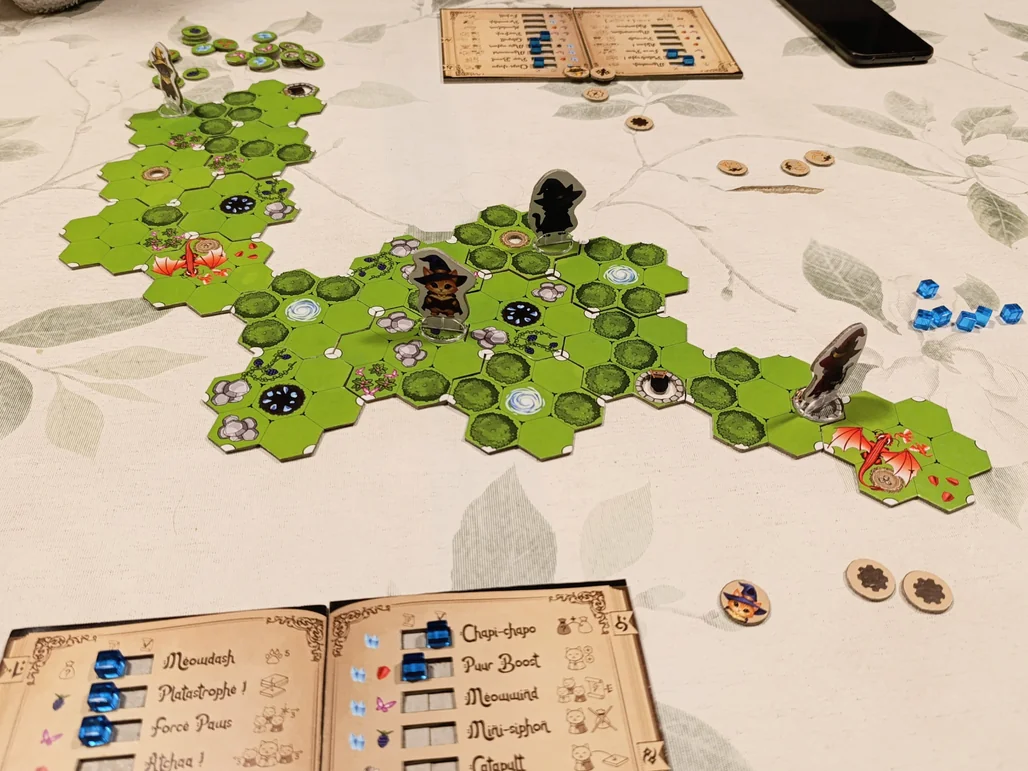
Board of green hexagonal tiles assembled on a leaf-patterned tablecloth, three wizard cat standees upright on transparent stands, two red dragons, and an open grimoire in the foreground with blue cubes. The board during a game

The board in the thick of a game

The board in the thick of a game, still on the move. The games are as much fun as ever and no two are alike. The apprentices standing on their stands follow the movement, the dragons are ever present, and the grimoires fill up with spells thanks to the cubes. The tiles are still a very long way from their final design.

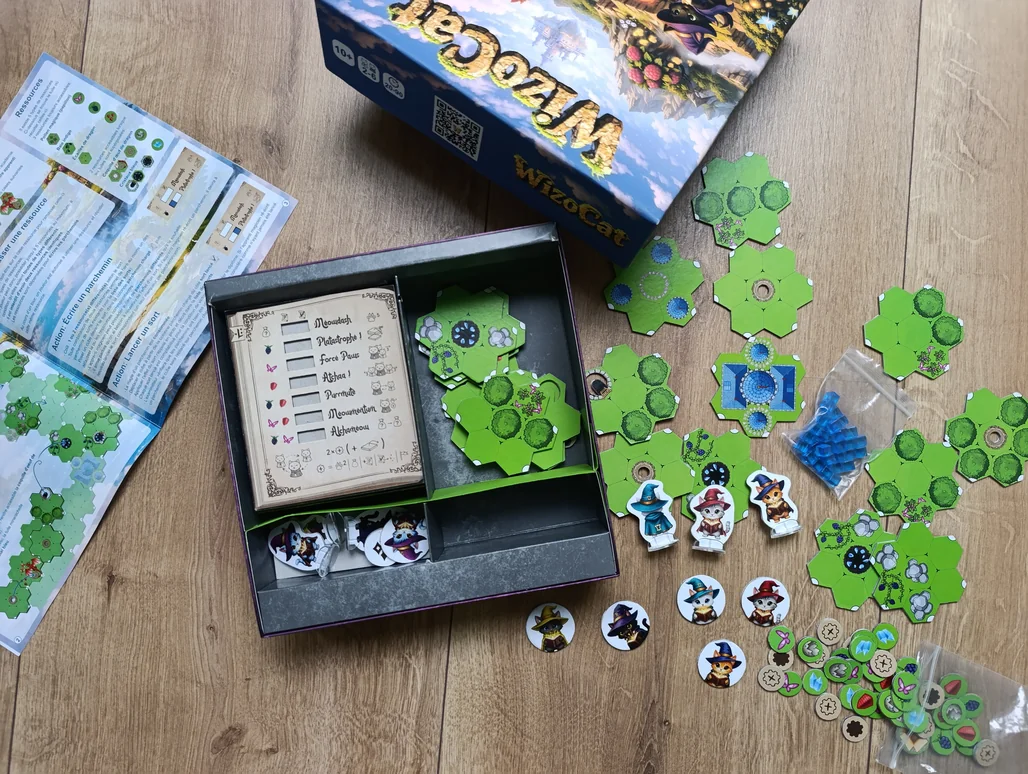
WizoCat box open on a light wooden floor, lid standing behind it: grimoire in its compartment, green hexagonal tiles laid out, three wizard cat standees, round tokens, a bag of blue cubes and an unfolded rules sheet. The box, open

The box takes shape

Even the box is starting to look like a real game. I used the box from an expansion that was exactly the right size and glued my design onto it. I also reworked the rules booklet. The booklet is a double page, printed on both sides. The lore and story sheet will be kept separate from the rules of the game.

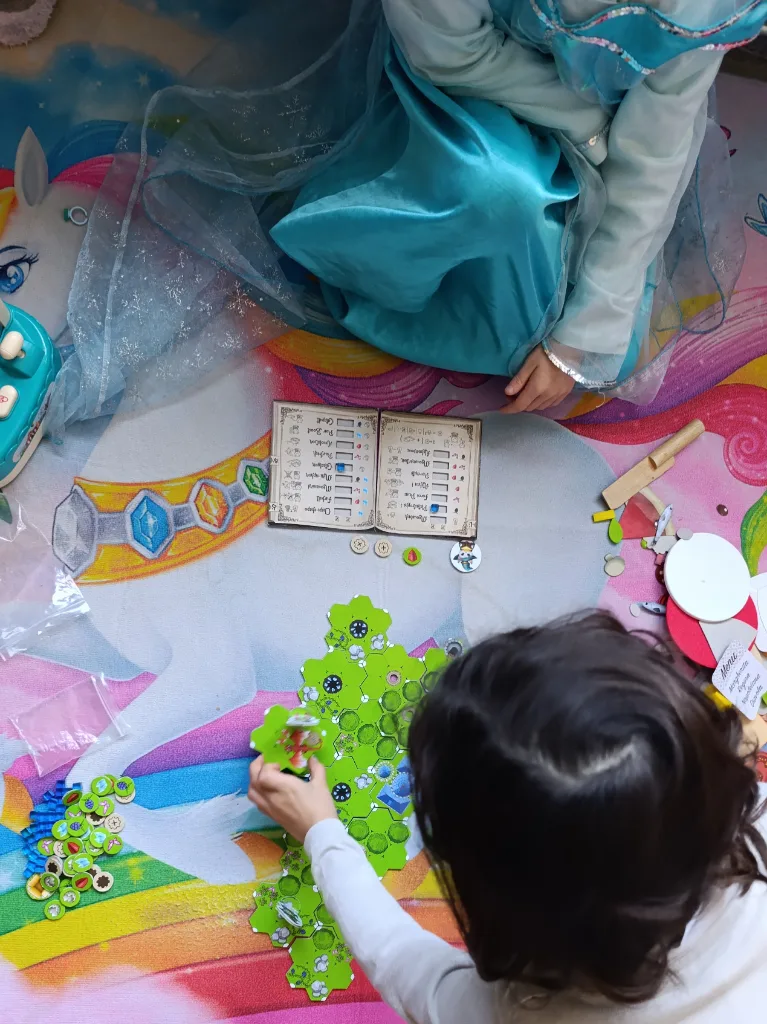
Top-down view of a colourful children's rug: two children seen from behind play on the floor, the board of green tiles set among toys, grimoires open on the wooden floor and tokens in piles. Players on the rug

The game leaves the table

A very important quality test. The game is played without a table. These two 8-year-old girls played a short 20-minute game… It was their first game and they played very well. They asked me if they could play more. One thing's for sure: their parents will be buying a box!

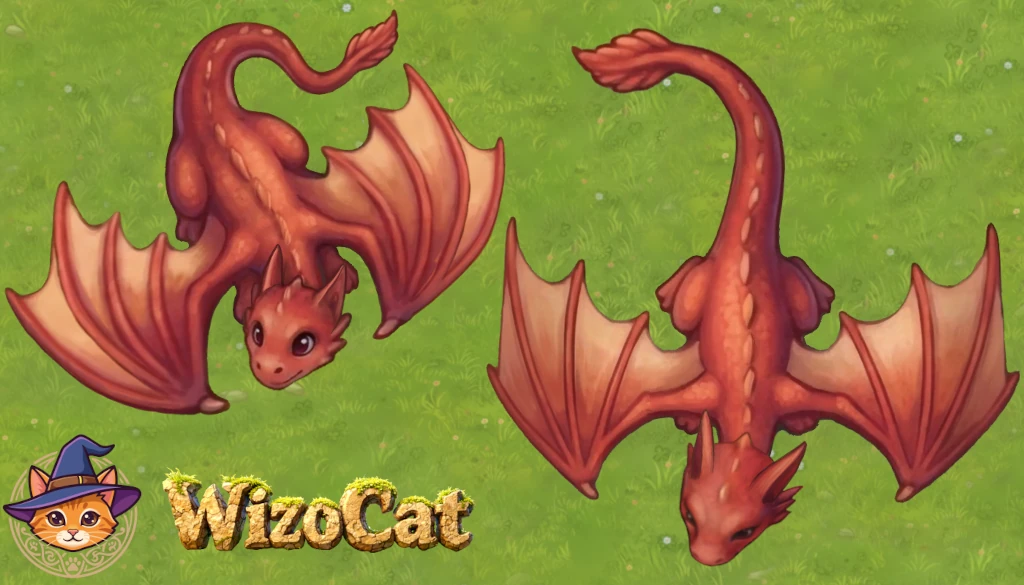
Two red dragon-dogs with spread wings and dog ears, on a green grass background, with the WizoCat logo bottom left. The dragon-dogs of the tiles

Dragons too big for the tiles

I made some nice big drawings. There's a male dragon and a female, and I drew the dragon pups too. A shame the tiles are smaller than the pictures I drew.

The official listing lands on BoardGameGeek

WizoCat officially joins the big league! The game's listing is now open on BGG, an unmissable milestone. It's also the moment the calendar firms up: after some calculations and thinking about production, the target is set for March 2027 for the Gamefound launch. Thanks to this page, anyone can add it to their favourites, which will lend a precious paw to the game's visibility.

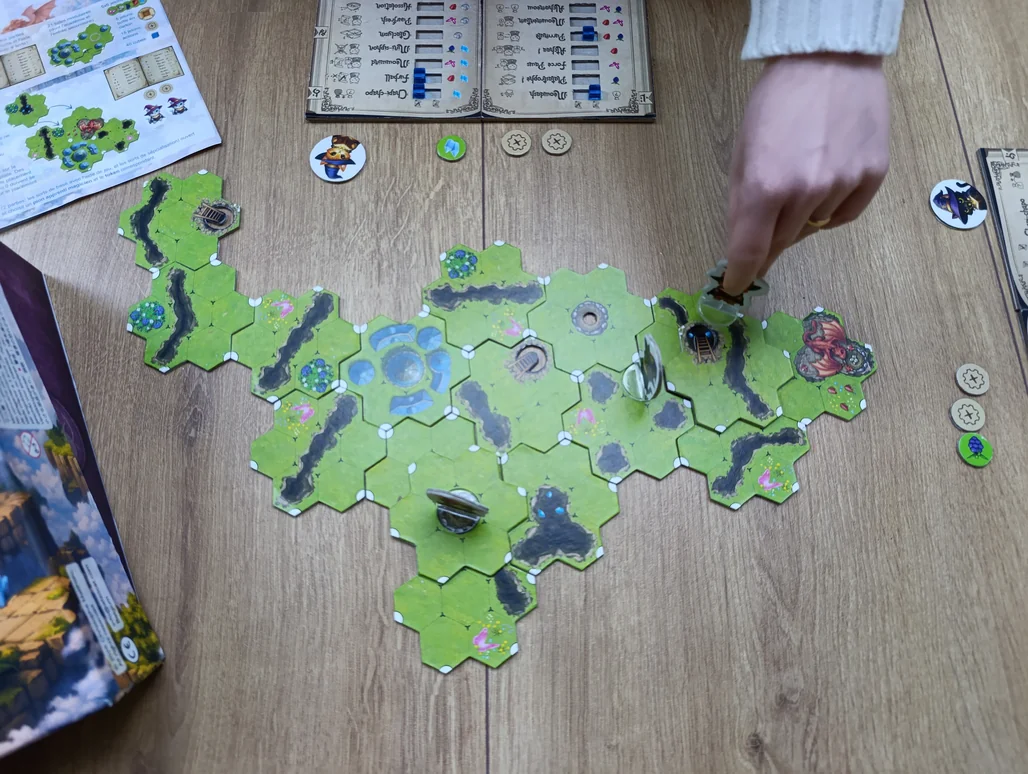
Top-down view of a wooden floor: a hand places a standee on a board of green tiles criss-crossed with dark crevasses, with round chasms and the Academy in the centre; open grimoires at the top, box and rules sheet on the left. The crevasse tiles

New tiles, with chasms and crevasses

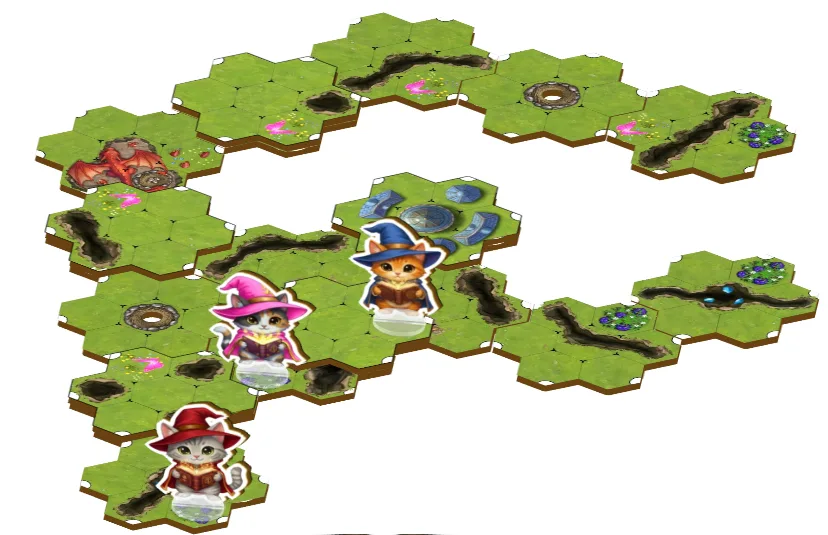
The tiles have changed; I was able to glue my new design onto them: crevasses run across them, there are chasms full of crystals, and ladders to go down and fetch them. Of course, there's also the dragon and its nest, along with the empty nest to lay on top so you can collect the shells.

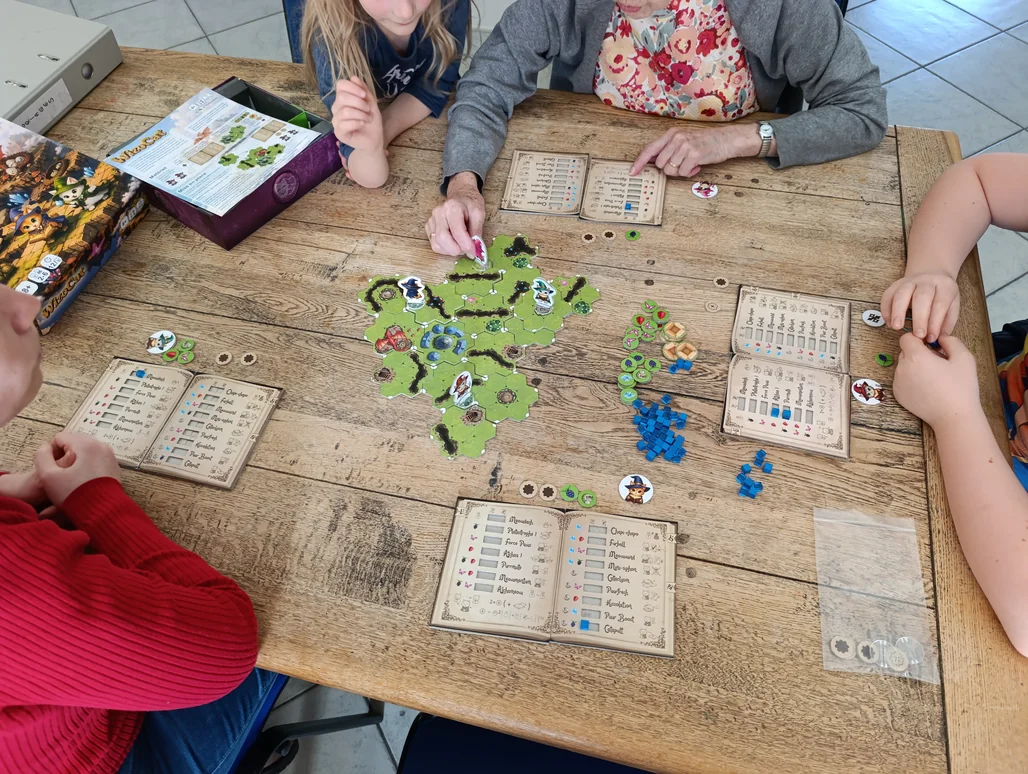
Big wooden table seen from above: two children, their grandmother and an adult are playing, board of green tiles in the centre, open grimoires, blue cubes, the WizoCat box open with the rules. Four players, three generations

Cross-generational tests full of lessons

Testing WizoCat with players of all ages and all backgrounds, one trend stands out clearly: children often play on instinct. Adults try harder to plan ahead. Some mostly want to laugh and stir up chaos, while others take pleasure in calculating every move. Everyone can have fun with WizoCat… but not everyone is looking for the same experience around the table.
And you, are you more team gleeful chaos or team master tactician?

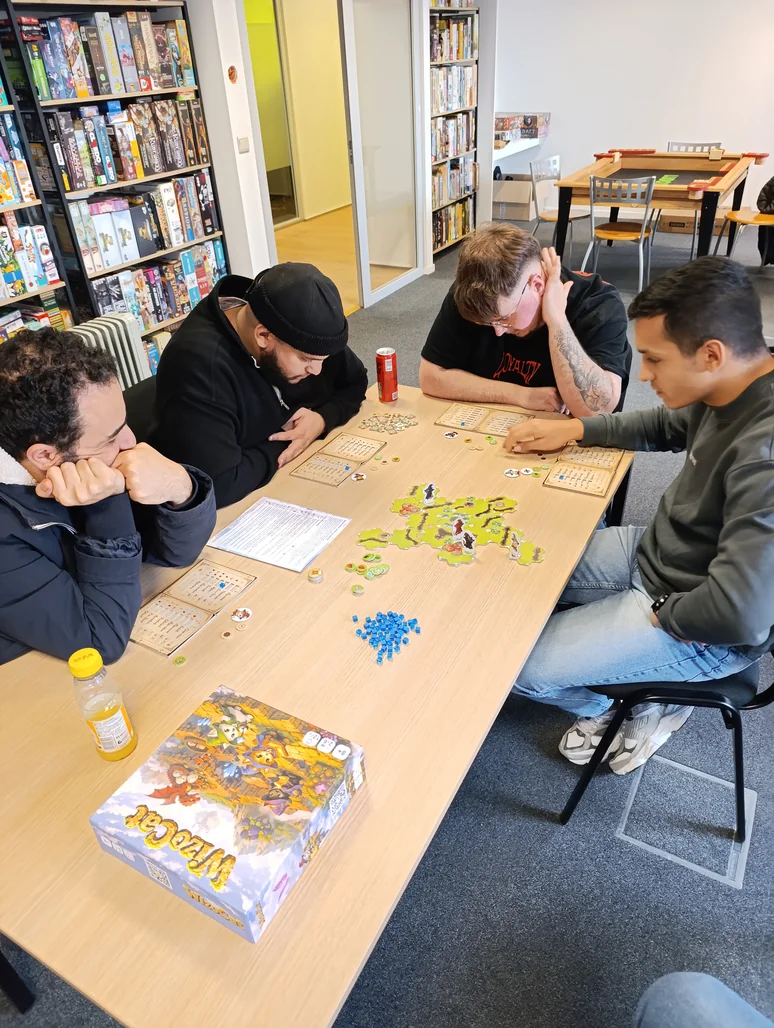
Four young adults concentrating around a light wooden table in a game shop with well-stocked shelves; board of green tiles in the centre, open grimoires, blue cubes, and the WizoCat box in the foreground. In the shop

The game shop pulls no punches

Four players who regularly meet up in this shop to play tactical games together. Lovely players… but ones who really don't pull their punches at the table!
Plenty of thinking, a few well-aimed blows and, above all, big bursts of laughter. A game just the way I like them.
Thanks to them for their welcome, their enthusiasm and their precious feedback on WizoCat!
A special wink for them: any latecomer will have one army removed from their board game, no questions asked! Even though, without that delay, I might never have met you.

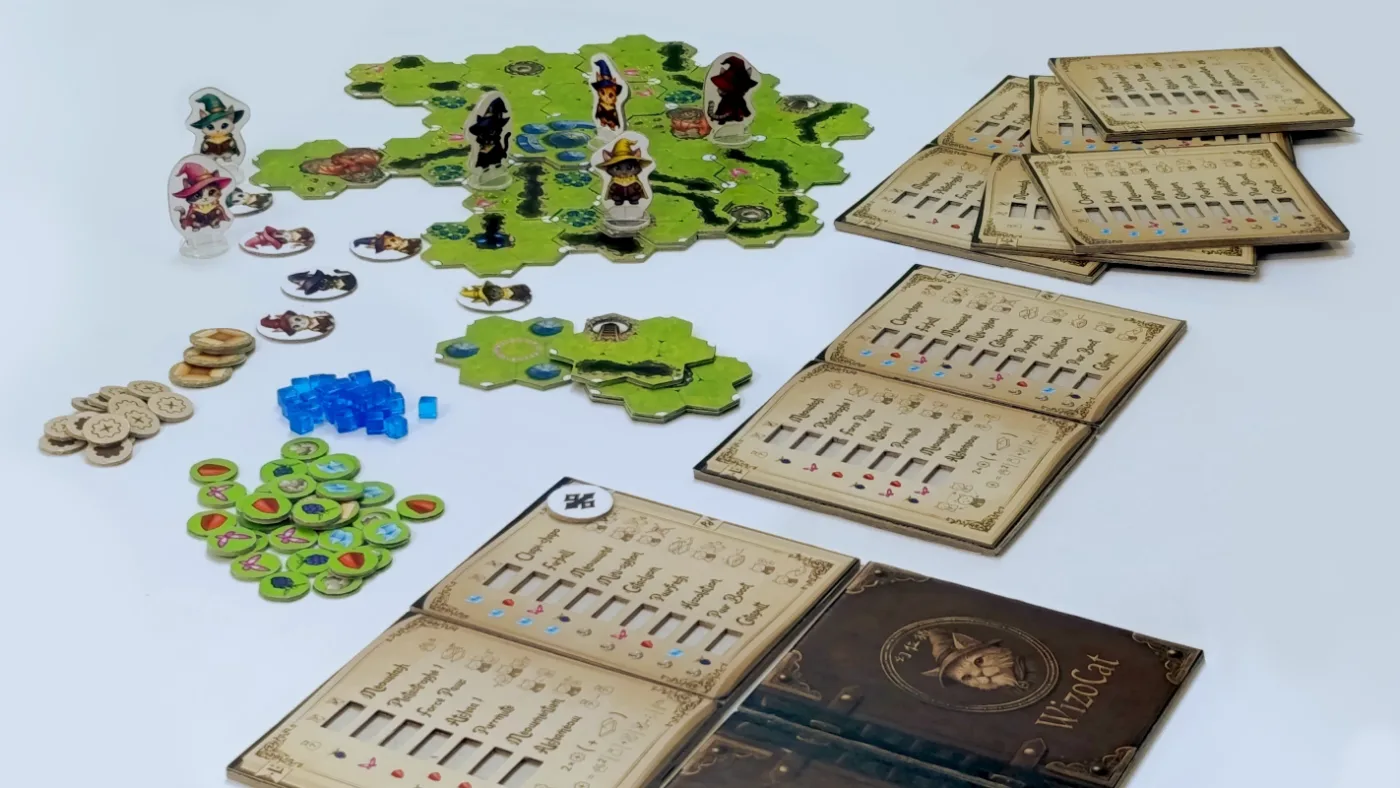
WizoCat's components laid out on a white background: board of cardboard hexagonal tiles, double-thickness cardboard grimoires, engraved tokens, blue cubes, wizard cat standees and the closed box. The components, on white

Everything is finally in the box

This is a turning point: the base game emerges from its box in its final form. The board takes its place, the grimoires unfold their double layers, the Academy tile finally goes double thickness: until then it was single thickness and kept getting crushed by accident, and that change makes the game flow better. The tokens and the cats stand up. I made the cardboard just as for a real game and cut it with the shapes for punching out the pieces. For the first time, it lets itself be photographed as what it really is: a real board game, not a cobbled-together mock-up. This photo will go on the back of the box. The game is no longer just a promise; it's a tangible reality.

Testing goes on, and the game is placed in a shop and a toy library to be tested in real conditions. People pick it, play it, and have fun without me around. The rules are clear. Victory!

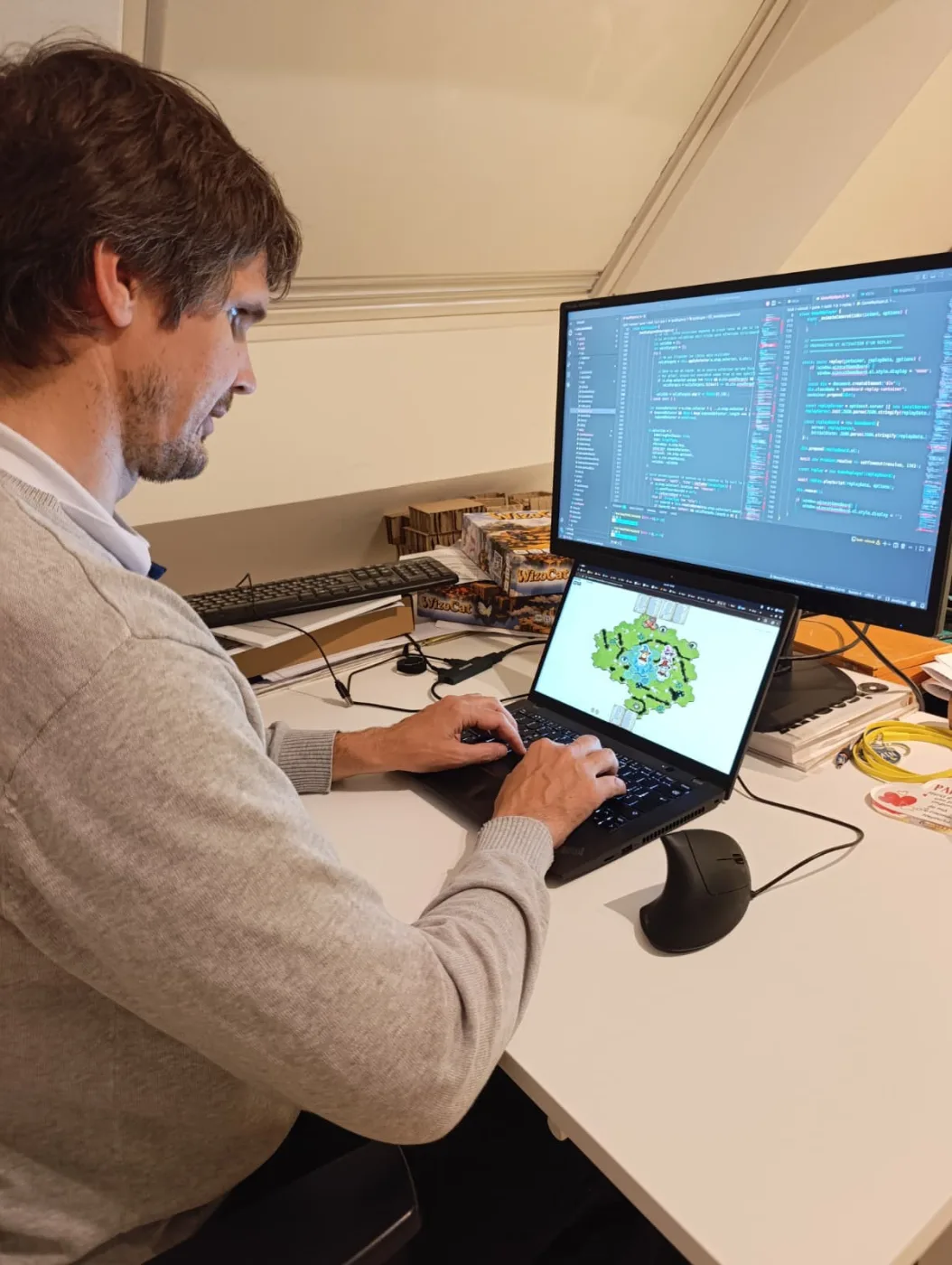
Christophe in profile at his desk, in front of two screens of code, the WizoCat board displayed on the laptop. Development

The other half of the job

Two screens of code, and the board running on the laptop next to them. The digital version isn't an adaptation made by someone else: it's the same workshop, the same person, a few months later.

I keep playing my game and having it tested. As with every game design, it will still take many games to check and work on the balance… To play thousands of them, I have an idea: I'm going to build an AI (MCTS), so that people can test and play online, and I'll run it on a big PC so it plays against itself. I'll test some hypotheses through the Monte Carlo Tree Search algorithm, and validate the improved versions with real games.

Screenshot of the online game: generated board of hexagonal tiles, four wizard cats of different colours placed on it. The first AIs

The board goes on screen

The online version starts playing by itself: a generated board, and four machine-driven apprentices moving around on it. You need opponents before you can test anything on your own.

The opponent matches your level

Facing you, in the browser, there's no pawn playing at random. At full strength, this AI beats a beginner and gets beaten by an experienced player, and that's precisely why it adapts to the level of whoever is playing, instead of sticking to its own.

The longest part wasn't making it win, but making it understand the point of the specialisation spells. It was winning very well without them, and that's a perfectly valid way to play, except that it was ignoring part of the grimoire in the process. It took several tuning sessions to get it to cast them because they're useful to it, not because it's forced to.

It has a limit, and I own it: it doesn't plan over several turns. The spells where the opponent keeps a choice therefore partly escape it, because the tactics there play out beyond its horizon. That's the price of the constraints I put on it: running in a browser, with no network, and even on a phone. Around a real table, you're the one in that role, and the game gains a lot from it.

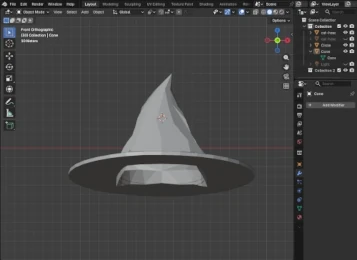
Wizard's hat modelled in 3D in Blender, seen from three-quarters on a grey background. The hat, in 3D

And now, in volume

Modelling the wizard's hat piece by piece: the essential step that turns the cardboard pawn into a 3D figurine.

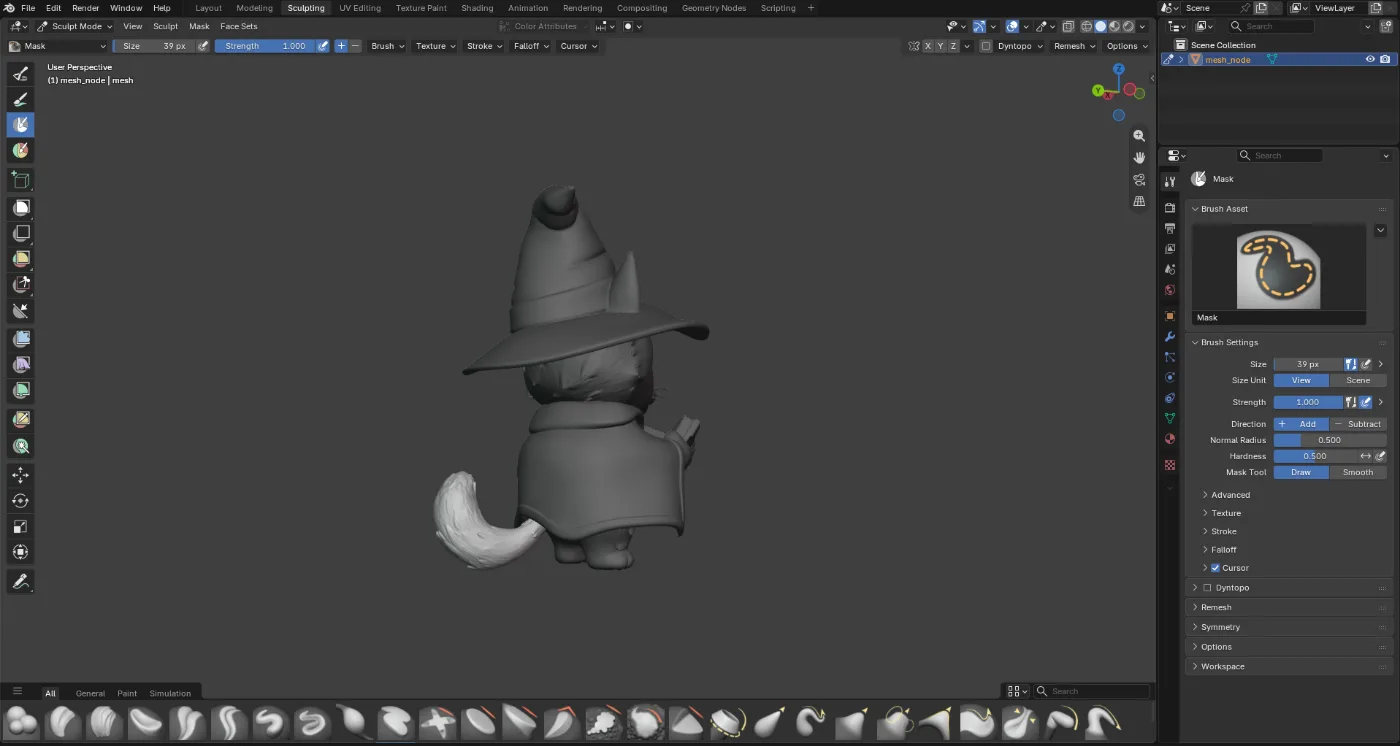
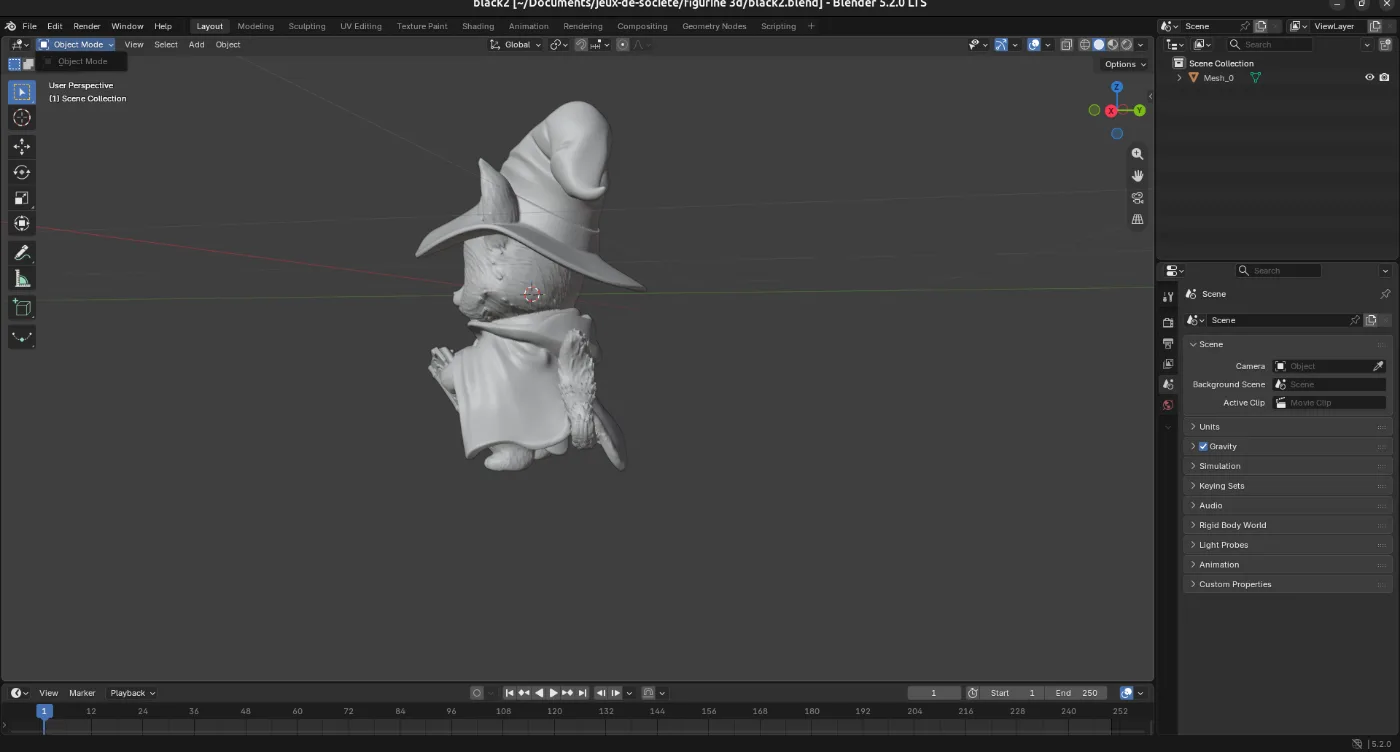
Blender showing a wizard cat modelled in 3D, standing and posed, with its library of parts at the bottom of the screen. The complete cat

The hat finds its cat

The whole character, assembled piece by piece and put in pose. At the bottom of the screen, the library of parts already modelled: that's what will make it possible to derive the six apprentices without starting over.

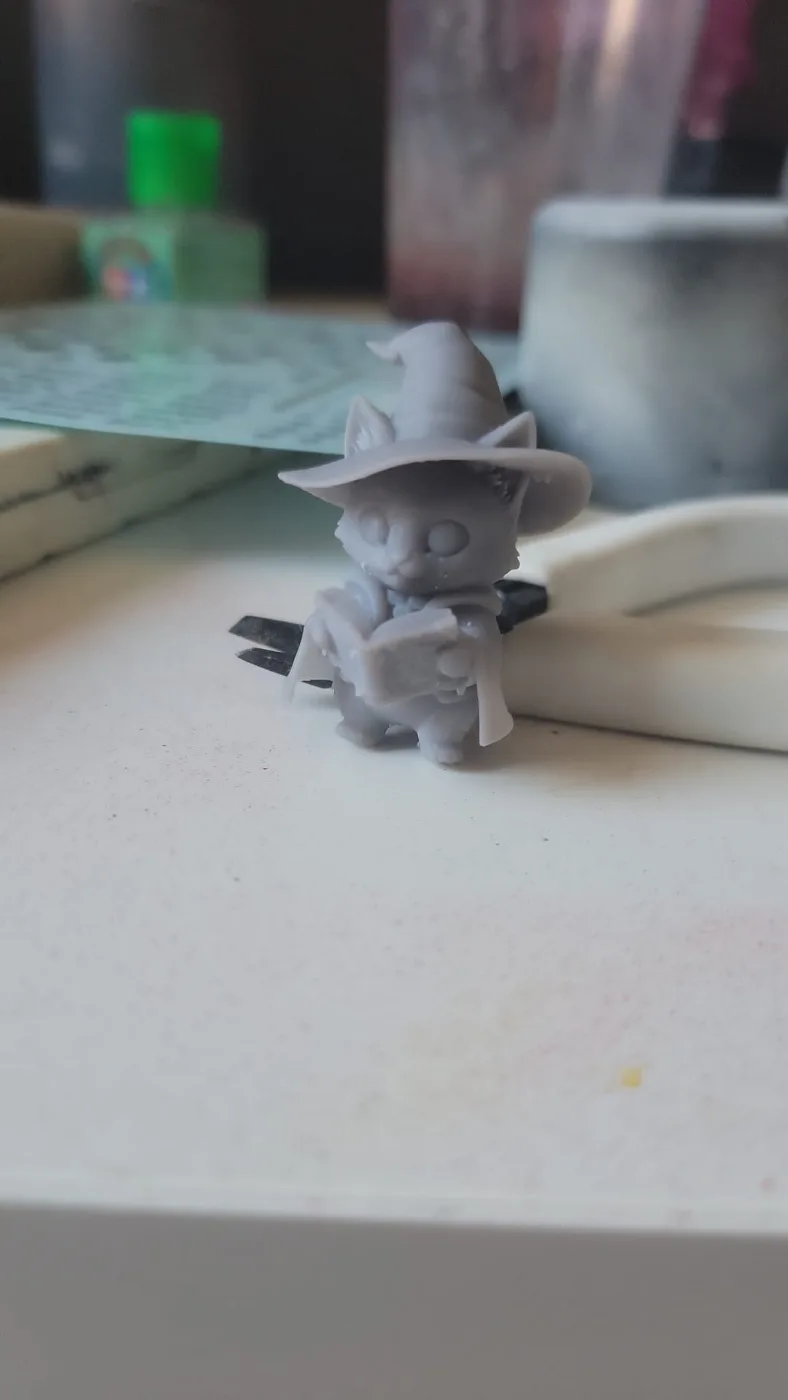
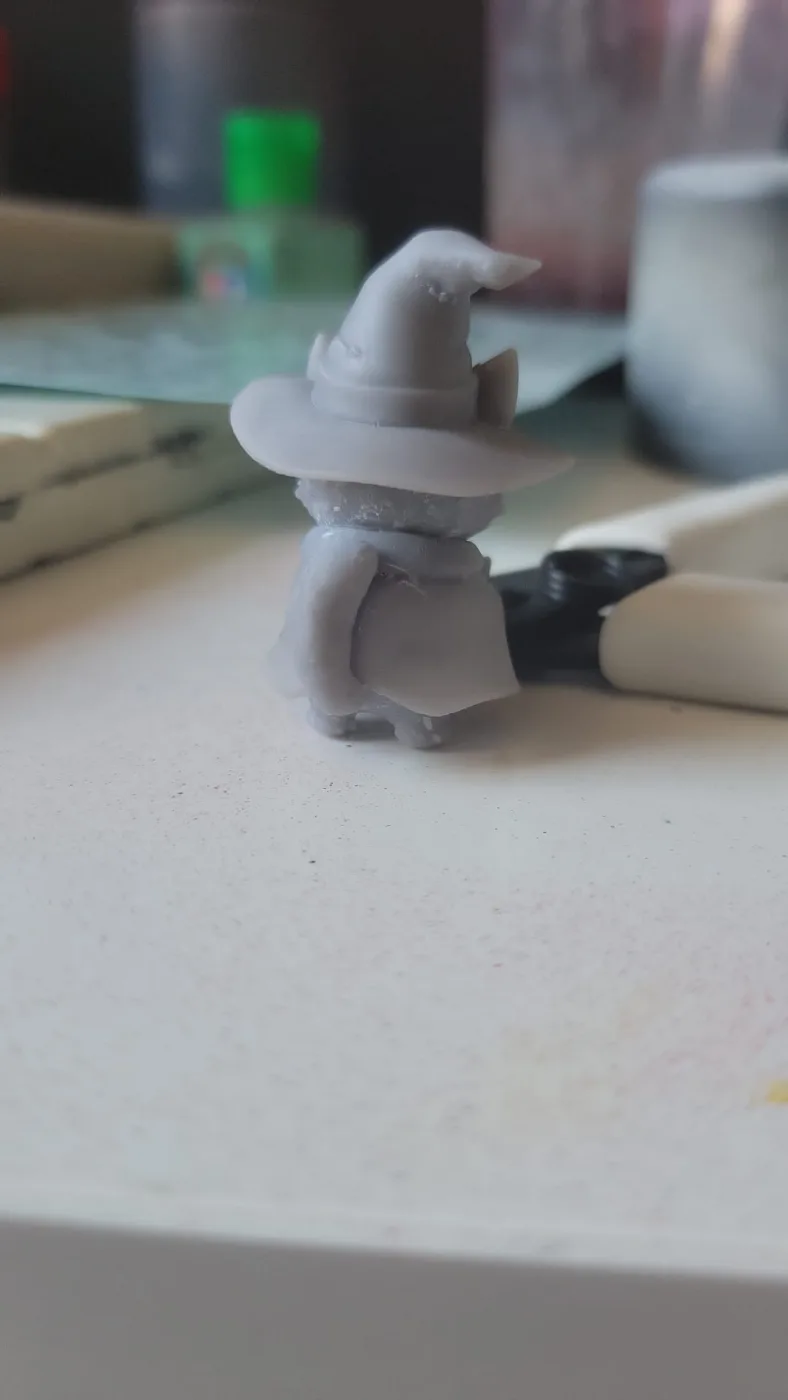
3D-printed wizard cat figurine, in grey plastic, standing on a worktop. The same 3D-printed wizard cat figurine, seen from another angle. The first printed figurine

The cat steps out of the screen

Grey, raw, unpainted: the first print of the wizard cat, held in the hand. This is the moment the game stops being a file.

Blender showing a wizard cat sculpted in 3D, being finished. The next one, being sculpted

The cat is no longer alone

The same day, a few hours after the first print: another cat being sculpted. Each apprentice has to be recognisable from the other end of the table.

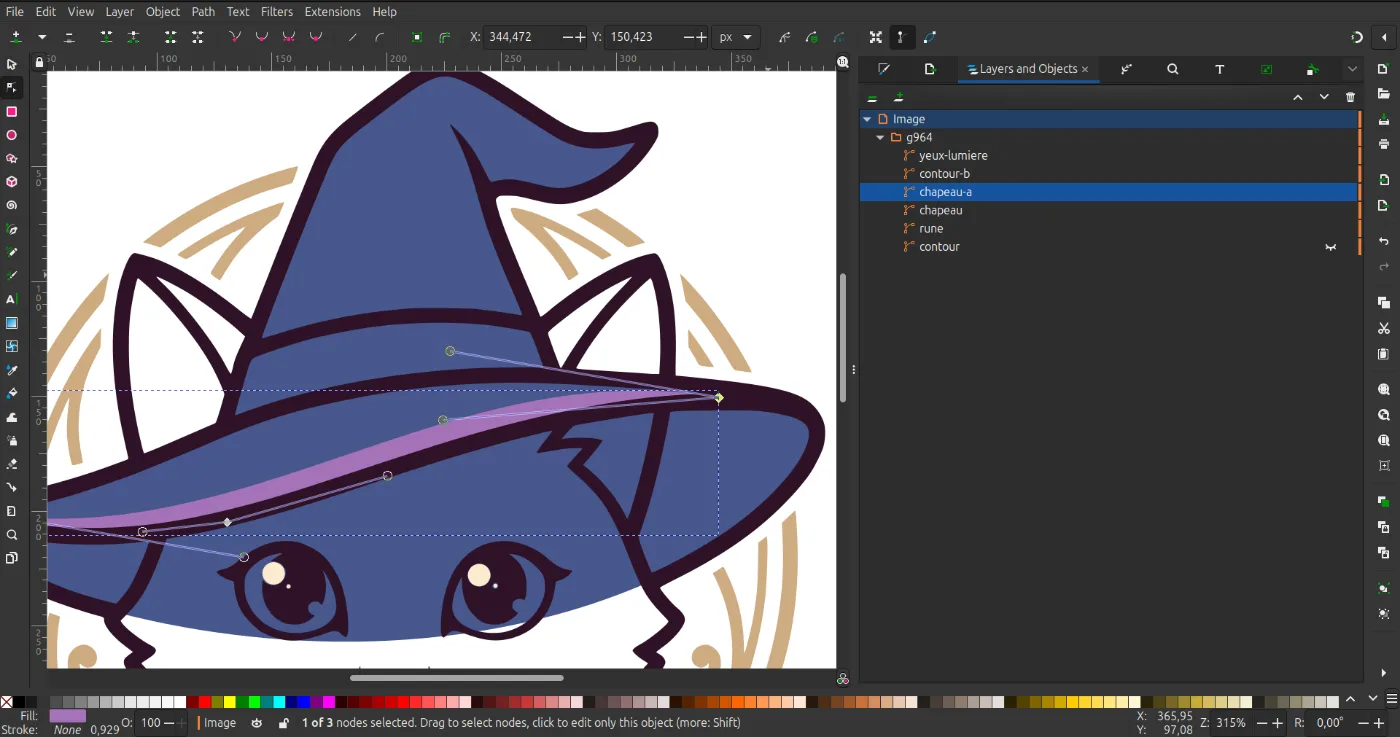
Vector drawing editor showing the WizoCat logo in progress: a cat's head under a big blue hat, inside a medallion. The logo, being traced

A head under a big hat

The logo is drawn in vectors, curve by curve: the cat's head, the hat that eats up half the image, the medallion around it. It's the one piece of the project that will show up everywhere, from the box to the app icon.

Shorter games at five and six players

A game that drags on at six players, and the urge to play fading before the end: that's the kind of evening you don't forget. I changed a rule to answer it; during testing, we called it the shuttle.

To validate the impact, I let the AI simulate complete games in depth. In a few seconds of computing on a PC, the reduction in the number of turns was clear. Around a real table with real players, that translated into 15 to 20 minutes saved at 5 and 6 players on games that used to last 90 to 100. The table remains the final judge: I'll keep testing to deliver the best game possible.

The adventure doesn't stop there: expansions are already planned to bring real asymmetry. Each one comes with its own player board, a unique tactic and a dedicated micro-rule, to renew the strategic challenges without making the base rules more complex.

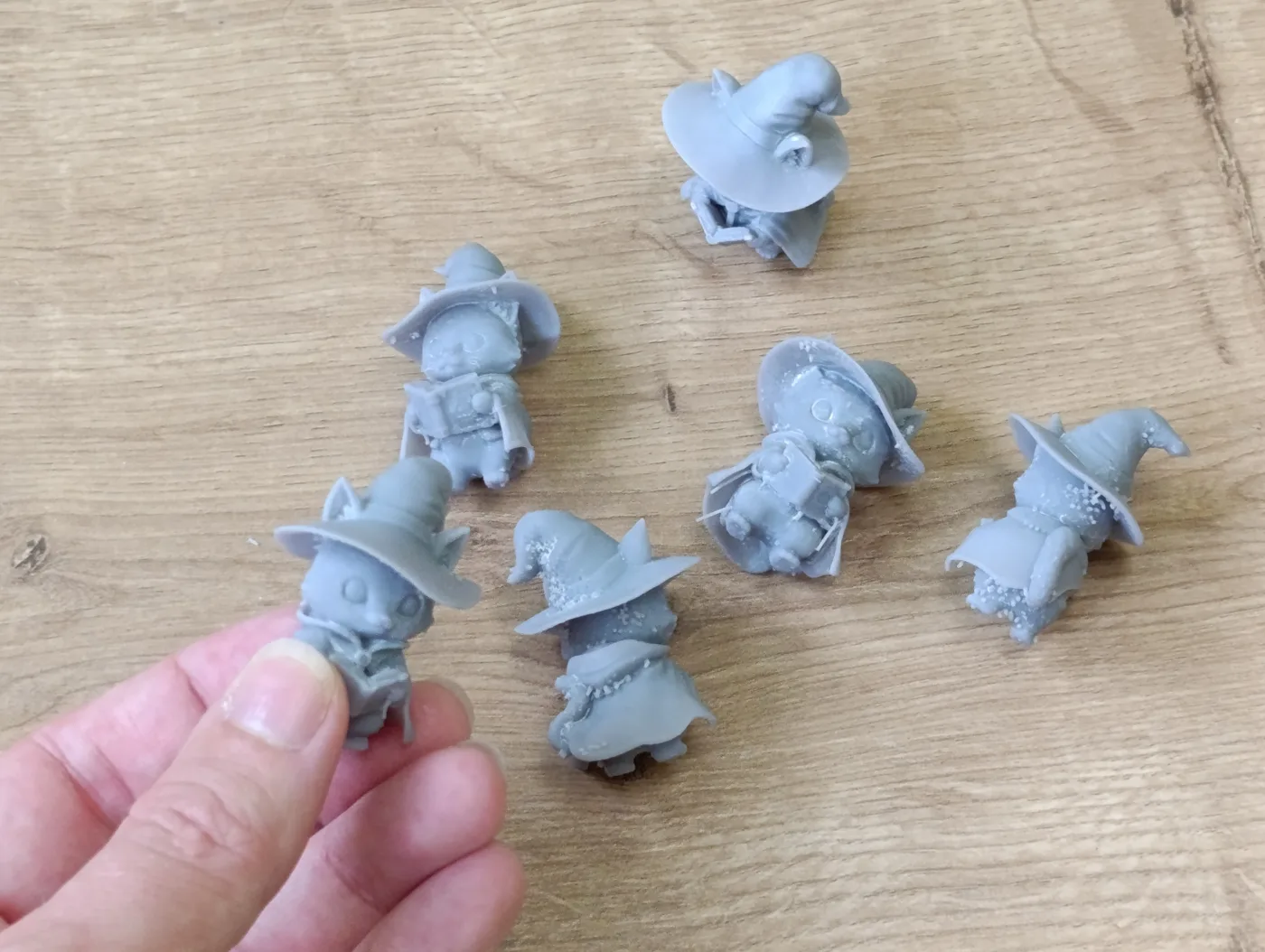
Six wizard cat figurines printed in 3D, grey and unpainted, on a light wooden work surface; a hand is holding one of them between two fingers. The full batch, straight out of the printer

Six apprentices on the workbench

This time it is no longer a single cat: the whole class came out of the printer. I picked them up one by one, and I am very happy with the result, and they hold together like a real little troop.

There is still a bit of cleaning up to do: a few support remnants to remove, the hats to rid of their specks. Then comes the painting. And then they will be magnificent.

🦋 A messenger butterfly

Something didn't work? Tell me what you were doing and what happened. It goes straight to the workshop.

Sent with your message: the page, your browser, the screen size, the language and the script's latest errors. Your address is only asked for if you want a reply: it is used for nothing else and is erased with the report, after 90 days.